
Series EE savings bonds are non-marketable U.S. Treasury securities purchased at face value. An electronic EE Bond earns interest monthly, compounds semiannually and can earn for up to 30 years. It cannot be sold to another investor, so its value does not rise and fall with a secondary-market quotation.
The fixed rate and semiannual compounding
For currently issued EE Bonds, the fixed rate is established at issuance and remains in effect for that bond. Interest accrues monthly. Every six months, accumulated interest is added to the bond's principal, allowing later interest to accrue on the larger value.
The fixed rate for a new purchase can differ from rates assigned in earlier issue windows. Always check the official TreasuryDirect EE Bond page for the current announcement. This guide intentionally does not present a dated rate as live data.
What the 20-year doubling provision means
Under current EE Bond terms, Treasury guarantees that an electronic EE Bond will be worth at least twice its purchase price when it reaches 20 years. If ordinary fixed-rate interest has not produced that value, Treasury makes a one-time adjustment at the 20-year point.
This is not the same as earning double the purchase price immediately, and it does not mean the bond always doubles before year 20. After 20 years, the bond can continue earning at its applicable rate until final maturity at 30 years. The exact terms for an older bond should be checked by issue date.
Illustrative timeline, not a return forecast
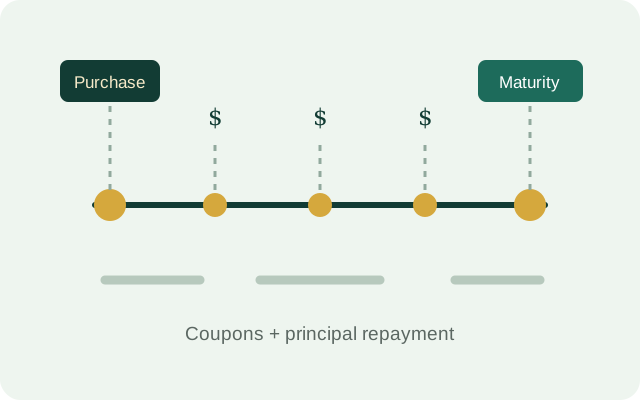
A $100 electronic EE Bond begins with a $100 purchase value. During the first 20 years it earns according to its fixed rate. If its value at year 20 is below $200, the current doubling provision calls for an adjustment to $200. Between years 20 and 30 it can continue accruing interest unless redeemed.
Purchase limits and early redemption
New electronic EE Bonds are available through eligible TreasuryDirect accounts. The general annual electronic purchase limit is $10,000 per Social Security Number or Employer Identification Number per calendar year. The legal registration can affect how that limit applies.
- Minimum electronic purchase: $25, with larger amounts available to the penny.
- First 12 months: the bond cannot normally be redeemed.
- After 12 months but before five years: redemption generally forfeits the last three months of interest.
- After five years: that three-month early-redemption penalty no longer applies.
- At 30 years: the bond reaches final maturity and stops earning interest.
The standard 12-month redemption restriction and early-redemption interest penalty still apply. Do not treat a 20-year feature as immediate liquidity or as a personalized reason to purchase.
EE Bonds versus I Bonds
| Question | EE Bond | I Bond |
|---|---|---|
| What determines interest? | A fixed rate set at issuance | A fixed component plus an inflation component |
| Can the stated rate reset? | The fixed rate does not reset for that bond | The composite rate changes for each bond every six months |
| Distinctive long-term feature | At least double purchase value at 20 years under current terms | Composite rate has a zero-percent floor |
| Annual electronic purchase limit | Generally $10,000 per eligible registrant | Generally $10,000 per eligible registrant, separate from EE |
| Early access rules | 12-month lockup; possible three-month penalty before five years | Same standard framework |
The two series are separate for the general annual electronic limit, but eligibility and registration details matter. Read our complete I Bond guide before comparing a resetting composite rate with an EE Bond's fixed rate.
Federal and state tax treatment
EE Bond interest is generally taxable at the federal level and exempt from state and local income tax. Reporting may generally be deferred until the year proceeds are received or the bond reaches final maturity, or an owner may elect annual reporting. The year of redemption or maturity can therefore include interest accrued over many years.
Qualifying savings bonds used for eligible higher-education expenses may support a federal interest exclusion, but only when every IRS condition is satisfied. Owner age, issue date, registration, filing status, income and qualified expenses can all matter. See IRS Publication 970 and Form 8815.
Records, older bonds and final maturity
Electronic holdings appear in the owner's TreasuryDirect account. Older paper EE Bonds require different servicing procedures. Keep serial numbers and ownership records, check whether a bond has stopped earning, and use official instructions for replacement, redemption or estate questions.
Bond Atlas cannot access personal records or determine the value of a specific bond. TreasuryDirect provides official valuation tools and account support. Never provide account passwords or sensitive identity information to an informational website.
EE Bond reading checklist
- Confirm the fixed rate for the exact issue window on TreasuryDirect.
- Distinguish the 20-year doubling provision from annual interest accrual.
- Check the 12-month lockup and five-year penalty threshold.
- Review legal ownership and beneficiary registration.
- Consider when deferred federal interest may become reportable.
- For older holdings, verify whether the bond has reached final maturity.
Official sources and related reading
- TreasuryDirect — EE Bonds: current rates, purchase and redemption rules.
- TreasuryDirect — Tax information for EE and I Bonds.
- IRS Publication 970 — Tax Benefits for Education.
Reviewed November 6, 2026. General educational information, not a current rate alert or individualized recommendation.