
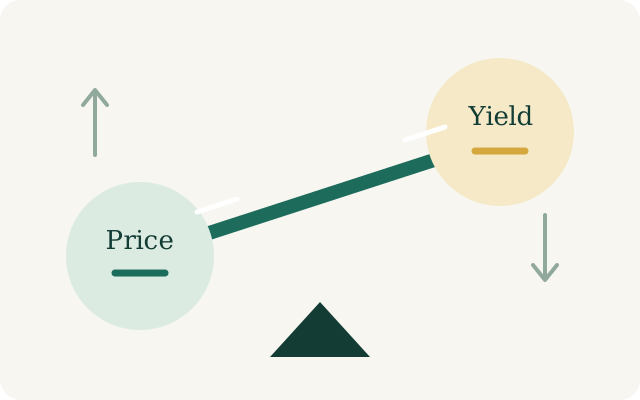
The market price of a bond is the present value of its expected cash flows, adjusted for the risks and terms attached to those cash flows. When the return investors require changes, the price of an existing fixed-rate bond adjusts. The coupon printed on the bond does not.
For a conventional fixed-rate bond, higher market yields generally mean a lower price, and lower market yields generally mean a higher price. This is a pricing relationship, not a forecast of what interest rates will do next.
Price, coupon and yield are different measurements
Confusion often begins when “interest rate” is used for several different numbers. Separating them makes bond quotations much easier to read.
| Term | What it means | Does it change after issuance? |
|---|---|---|
| Face value (par) | The principal amount used to calculate coupon payments and normally repaid at maturity | Usually fixed; inflation-linked principal is an exception |
| Coupon rate | Annual coupon as a percentage of face value | Fixed for a fixed-rate bond; resets for a floater |
| Market price | The amount at which the bond trades, often quoted as a percentage of par | Can change continuously |
| Current yield | Annual coupon divided by current market price | Changes with price; ignores gain or loss at maturity |
| Yield to maturity (YTM) | The annualized rate that equates the purchase price with promised coupons and principal, under stated assumptions | Changes with price and time |
| Yield to call (YTC) | A yield calculation assuming the bond is called on a specified date at its call price | Relevant only when call terms exist |
A $1,000 bond with a 4% coupon pays $40 per year, commonly as two $20 semiannual payments. If its price is $950, its current yield is approximately $40 ÷ $950 = 4.21%. That calculation does not include the additional $50 principal difference if the bond matures at $1,000. YTM incorporates that difference and the timing of every promised payment.
A standard YTM calculation assumes payments arrive as promised and generally assumes coupon reinvestment at the same yield. Default, calls, taxes, transaction costs and different reinvestment rates can change the realized result.
Why prices and yields move in opposite directions
Imagine that you own a bond paying $40 a year, while newly issued bonds with similar risk and maturity pay $50. No rational buyer would pay the same price for your smaller cash flow unless some other feature compensated for it. The existing bond's price generally falls until its overall yield is competitive.
The reverse happens when new comparable bonds pay less. Your higher coupon becomes more valuable, so buyers may pay a premium. The price adjusts because the contractual coupon itself cannot.
Worked example: the same bond at three yields
Assume a bond has a $1,000 face value, a 4% annual coupon paid semiannually, exactly five years remaining, and no call or default. Discounting ten $20 coupon payments and the final $1,000 principal gives:
| Required annual yield | Approximate present value | Price relative to par |
|---|---|---|
| 3% | $1,046.11 | Premium: about 104.61 |
| 4% | $1,000.00 | At par: 100 |
| 5% | $956.24 | Discount: about 95.62 |
The cash flows are identical in all three rows. Only the discount rate changes. The calculation ignores accrued interest, taxes, transaction costs and intraday settlement conventions.
Six forces that can change a bond's price
1. The general level of interest rates
Treasury yields form a reference point for much of the U.S. fixed-income market. Expectations about Federal Reserve policy, economic growth and inflation influence these yields. A bond does not need a change in its own coupon for its price to respond to a change in the broader rate environment.
2. Inflation expectations
Nominal bond payments lose purchasing power when inflation rises. Investors may demand a higher nominal yield when expected inflation increases. TIPS respond differently because their principal adjusts with CPI-U, while I Bonds use a composite rate rather than a secondary-market price.
3. Credit spreads
A corporate bond's yield can be viewed as a comparable Treasury yield plus a spread for credit, liquidity and structural risks. If investors perceive greater default risk, the spread can widen and the price can fall even when Treasury yields do not move. Our corporate bond guide covers this analysis.
4. Liquidity and supply-demand imbalances
A bond that trades infrequently may require a larger discount to attract a buyer. Market stress, dealer capacity, a large new issue or concentrated selling can affect prices independently of a change in the issuer's long-term fundamentals.
5. Embedded options
A callable bond gives the issuer the right to redeem before maturity. That option can limit price appreciation when rates fall because the issuer may refinance. A putable bond gives the holder an early-redemption right under specified terms. Option-adjusted analysis may be more informative than a simple YTM.
6. Time remaining to maturity
For a bond that continues to perform, a discount or premium typically moves toward par as maturity approaches, all else equal. This is known as pull to par. It does not prevent interim price changes and does not rescue a bond whose issuer defaults.
Duration: measuring sensitivity, not just time
Maturity tells you when principal is due. Duration measures how sensitive a bond or bond fund's value is to a change in yields, taking into account the timing and size of cash flows. Macaulay duration is a weighted time measure; modified duration is commonly used to estimate percentage price sensitivity.
Using the approximation
If a bond has a modified duration of 6 and its yield rises by 1 percentage point, its price is estimated to fall by about 6%. If its yield falls by 1 percentage point, its price is estimated to rise by about 6%.
This is a local approximation, not an exact forecast. Convexity matters for larger yield moves, and duration itself changes with yields and time. For callable or otherwise option-heavy securities, effective duration is generally more relevant.
In general, longer maturities and lower coupons increase duration, all else equal. A zero-coupon bond can be especially sensitive because all of its cash arrives at maturity. But low duration does not mean low overall risk: credit, liquidity, inflation and call risks may remain.
What changes if you hold to maturity?
For a conventional bond that performs as promised, interim market quotations do not alter the contractual coupon or principal due at maturity. A holder who does not sell may therefore experience price volatility on statements without realizing a market loss. This does not eliminate opportunity cost, inflation, default risk or reinvestment risk.
If the bond is sold before maturity, the available market price directly affects the result. If a bond is held inside a fund, there is no single maturity date belonging to the investor: the fund continually manages holdings, and its share price reflects the portfolio. That distinction is central to comparing individual bonds and ETFs.
Series I and EE savings bonds are non-marketable. Their values follow Treasury accrual and redemption rules rather than secondary-market price fluctuations. Read the I Bonds guide before applying market-price concepts to them.
The yield curve and relative pricing
The Treasury yield curve plots yields across maturities at a point in time. It can slope upward, remain flat or become inverted. Its shape reflects a combination of policy expectations, inflation expectations, growth outlook and term premium—not a single mechanical forecast.
When analysts discuss a corporate or municipal bond, they often compare its yield with a similar-maturity benchmark. That spread can be more informative than the coupon because it incorporates the bond's current price. Comparing only coupon rates can misleadingly favor a bond purchased at a large premium or one with substantially greater credit risk.
How to read a bond quote systematically
- Identify the issuer, exact security and CUSIP where available.
- Separate the coupon rate from current yield and YTM.
- Check whether the quoted price includes accrued interest.
- Read the maturity date and every call, put or conversion provision.
- Review duration and the benchmark used for the quoted spread.
- Look for recent trade activity and the difference between bid and ask prices.
- Account for credit risk, taxes, fees and the possibility of selling before maturity.
Frequently asked questions
Can a bond price fall even if the issuer is financially sound?
Yes. A general rise in market yields can lower the price of a high-quality fixed-rate bond. Creditworthiness is only one component of pricing.
Is a bond bought below par guaranteed to make money?
No. A discount does not eliminate default risk, call provisions, taxes, transaction costs or further price declines before maturity. The terms and issuer still matter.
Does the coupon change when the bond price changes?
For a conventional fixed-rate bond, no. The dollar coupon is based on face value. Current yield and YTM change because they use the market price.
Are longer bonds always more volatile?
Longer duration generally means greater interest-rate sensitivity, but credit events, embedded options and liquidity can also drive volatility. Maturity alone is an incomplete measure.
Do I Bonds fall when market interest rates rise?
I Bonds do not have a secondary-market price. Their composite rate changes under Treasury's savings-bond formula, and their redemption restrictions differ from marketable bonds.
Sources and further reading
- FINRA — Interest Rate Changes and Duration: inverse price-rate relationship and duration examples.
- FINRA — Understanding Bond Yield and Return: current yield, YTM and total return.
- Investor.gov — What Are Corporate Bonds?: discount, premium, yield and risk examples.
- TreasuryDirect — Marketable Securities: security types and payment structures.
Examples are simplified illustrations, not live quotations or predictions. Reviewed November 5, 2026.