
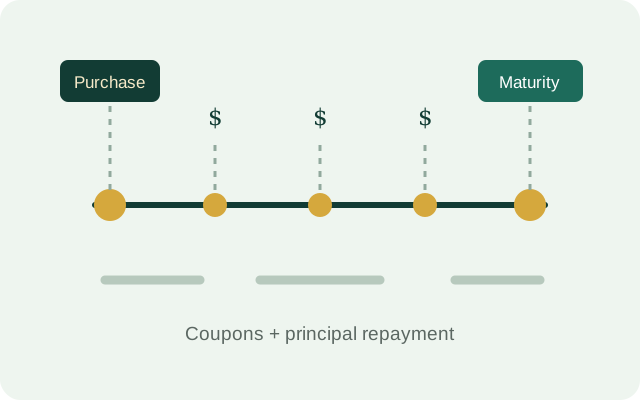
A bond is a form of borrowing. The issuer receives money and promises to repay it under a legal agreement. The investor becomes a lender, not an owner of the issuer. That simple distinction explains much of the difference between bonds and stocks.
A bond's face value, coupon, maturity, seniority and redemption provisions determine what the investor is promised. The market price determines what the investor pays for that promise.
How a bond works
Suppose an issuer sells a bond with a $1,000 face value, a 4% annual coupon and a five-year maturity. In a simple fixed-rate structure, the issuer pays $40 per year—commonly two $20 payments—and repays $1,000 at maturity.
- Issuance: the borrower sells the bond and receives the issue proceeds.
- Holding period: the issuer makes promised interest payments, if the bond has periodic coupons.
- Secondary trading: a marketable bond can change hands at a price above or below face value.
- Maturity: the issuer repays principal according to the contract, unless the bond was called, defaulted on or otherwise redeemed.
Why purchase price matters
If an investor pays $950 for the bond above, the coupon remains $40 a year and the contractual maturity principal remains $1,000. The buyer has a current yield of about 4.21% before considering the $50 difference between purchase price and principal. If the investor pays $1,050, the coupon is still $40, but the current yield falls to about 3.81%.
The seven essential terms
1. Issuer
The borrower. It can be the U.S. Treasury, a company, a state or local government, an agency or another entity. The issuer's identity is central to credit and tax analysis.
2. Face value or par value
The principal amount on which coupon payments are based and which is normally due at maturity. It is not necessarily the purchase price.
3. Coupon
The interest rate applied to face value. A fixed coupon stays constant; a floating coupon resets under a specified formula. Zero-coupon securities do not make periodic interest payments.
4. Maturity
The date principal is due. Remaining maturity changes as time passes, and a call provision can result in earlier repayment.
5. Price
The market value of the bond, often quoted as a percentage of par. A price of 98 means $980 per $1,000 of face value; 103 means $1,030.
6. Yield
A return calculation based on price and cash flows. Current yield only divides annual coupon by price. Yield to maturity also incorporates principal and payment timing under stated assumptions.
7. Seniority and collateral
These legal features determine the bondholder's position among creditors. A secured bond has specified collateral; a subordinated bond ranks below more senior obligations.
Major categories in the U.S. market
| Category | What defines it | Where to learn more |
|---|---|---|
| Treasury marketable securities | U.S. government bills, notes, bonds, TIPS and FRNs that can trade before maturity | Treasury market guide |
| U.S. savings bonds | Non-marketable EE and I securities with special purchase, accrual and redemption rules | I Bonds guide |
| Corporate bonds | Company debt with credit, structural and liquidity risks | Corporate analysis guide |
| Municipal bonds | State and local government-related debt, often with special tax treatment | Municipal tax section |
| Bond funds and ETFs | Pooled portfolios rather than one issuer's individual obligation | Comparison guide |
Why the market price changes
Existing fixed-rate bonds compete with newly issued securities and other opportunities. When comparable market yields rise, an older bond's lower coupon becomes less attractive and its price generally falls. When yields decline, the older higher coupon becomes more valuable and its price generally rises.
Interest rates are only one driver. Credit quality, inflation expectations, liquidity, time to maturity and issuer call rights also matter. Duration estimates sensitivity to yield changes; it is not the same as maturity.
Read the full worked example in how bond prices change.
The main risks in plain English
- Credit or default risk: the issuer does not make promised payments on time.
- Interest-rate risk: market value falls when yields rise, especially for higher-duration securities.
- Inflation risk: fixed payments purchase less in the future.
- Reinvestment risk: coupons or returned principal are reinvested at a lower rate.
- Call risk: the issuer redeems early, often when early redemption benefits the issuer.
- Liquidity risk: selling quickly may require an unfavorable price or wide spread.
- Tax and reporting risk: interest, accruals and sales can produce different liabilities and records.
The coupon may be fixed while the market price changes. Even U.S. Treasury securities can lose market value before maturity, and corporate bonds also carry issuer default risk.
Where I Bonds fit—and where they do not
Series I savings bonds belong to the broad bond category but not to the secondary bond market. They cannot be sold to another investor, do not have a fluctuating market quotation and have a $10,000 general annual electronic purchase limit per eligible SSN or EIN.
Their rate combines a permanent fixed component with an inflation component that changes every six months from the bond's issue-month schedule. They cannot be redeemed for 12 months, and redemption before five years generally forfeits the last three months of interest. Those are savings-bond rules, not market-price rules.
Where different bonds are bought
New savings bonds are purchased electronically through TreasuryDirect. Marketable Treasury securities can be acquired at auction through TreasuryDirect or financial institutions and later traded through brokers. Corporate and municipal bonds are generally accessed through brokers, dealers or funds. Bond ETF shares trade on stock exchanges.
Each channel has different account, pricing, disclosure and transaction-cost considerations. Bond Atlas does not open accounts or process transactions; these descriptions are navigational only.
A sensible order for learning the subject
- Read prices, yields and duration to understand market quotations.
- Use the Treasury guide to separate bills, notes, bonds, TIPS and savings bonds.
- Read the I Bonds guide for composite rates and redemption rules.
- Study corporate credit analysis before focusing on a high coupon.
- Review tax categories and the individual bond versus ETF comparison.
- Use the glossary whenever a quotation introduces unfamiliar terminology.
Frequently asked questions
Is a bond the same as a loan?
Economically, a bond represents borrowing, but it is a standardized security with specific transfer, payment and legal terms. The investor is a creditor rather than an equity owner.
Can a bond be worth less than its face value?
Yes. Marketable bonds can trade below par because of rates, credit, liquidity or other terms. Face value is the contractual principal measure, not a continuously guaranteed sale price.
What is the difference between coupon and yield?
The coupon is based on face value. Yield uses the market price and, for YTM, payment timing and principal. Two bonds with the same coupon can have different yields.
Are bonds insured bank deposits?
No. Bonds are securities, not ordinary bank deposits. FDIC deposit insurance and U.S. Treasury backing are separate concepts and should not be used interchangeably.
Can I lose money in a bond fund?
Yes. A fund's share price changes with its portfolio, and it has no personal maturity date. Diversification does not eliminate market, rate or credit losses.
Sources and further reading
- Investor.gov — Bonds: Benefits and Risks.
- FINRA — Bonds: coupons, maturities, structures and risks.
- TreasuryDirect — Marketable Securities.
- TreasuryDirect — I Bonds.
Examples are simplified and ignore taxes and transaction costs unless stated. Reviewed November 5, 2026.