
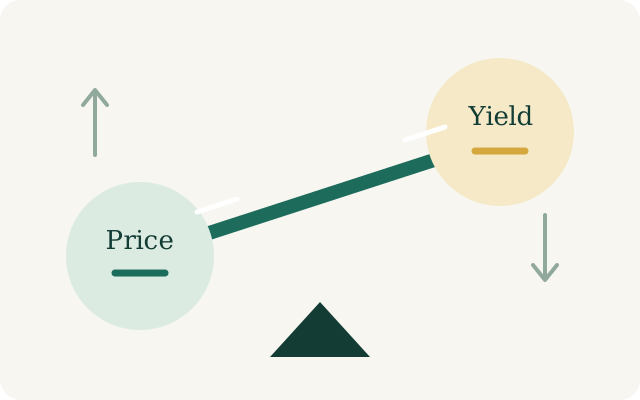
Bonds are often described by coupon and yield, but no single number summarizes the outcome. Market prices can fall, issuers can fail to pay, inflation can reduce purchasing power and account rules can restrict access. Even U.S. Treasury securities carry interest-rate and inflation risks despite their backing.
This guide is general education, not a personal risk assessment. Securities involve risk, including possible loss of principal. Diversification, government backing and inflation-linked features do not assure a profit or prevent every loss.
Interest-rate and duration risk
When market yields rise, prices of existing fixed-rate bonds generally fall because their contractual payments become less attractive relative to new yields. When yields fall, prices generally rise. Duration estimates sensitivity to a yield change under simplified assumptions.
A bond with a five-year modified duration would lose roughly 5% if its yield rose one percentage point, before considering convexity and other factors. The approximation becomes less precise for large yield changes and bonds with embedded options.
Holding an individual performing bond to maturity can reduce the need to sell at a depressed market price, but it does not eliminate inflation, reinvestment, opportunity or issuer risk. Read the full bond price and duration guide.
Credit and default risk
Credit risk is the possibility that an issuer's ability or willingness to make promised payments deteriorates. Default can lead to missed interest, delayed principal, restructuring or loss. Ratings provide an opinion, not a guarantee.
Corporate analysis considers cash flow, leverage, interest coverage, assets, covenants and seniority. Municipal analysis focuses on the legal pledge and relevant tax or project revenues. Two bonds with the same coupon and maturity can have very different credit risk.
Liquidity and transaction-cost risk
Liquidity risk means a security may be difficult to sell quickly at a fair or expected price. Bid-ask spreads can widen during market stress, and some corporate or municipal issues trade infrequently. A quoted valuation is not necessarily an executable sale price.
Fund shares may trade daily even when underlying holdings are less liquid. That can create additional pricing and flow dynamics during stressed markets.
Inflation and purchasing-power risk
A fixed coupon buys fewer goods and services when prices rise. The nominal payment can arrive exactly as promised while its real value declines. Longer holding periods can increase uncertainty about cumulative inflation.
TIPS adjust principal using CPI-U, and I Bonds include a CPI-U-linked rate component. Those mechanisms address a particular inflation measure but do not remove market, timing, tax, purchase-limit or access constraints. Compare TIPS and I Bonds by structure rather than assuming they eliminate inflation risk.
Call, prepayment and reinvestment risk
A callable bond allows the issuer to redeem early under specified terms. An issuer may call when rates fall, leaving the holder to reinvest at lower yields. Mortgage-related securities can also face prepayment behavior that changes expected cash flows.
Reinvestment risk applies to coupon payments as well: a yield-to-maturity calculation commonly assumes coupons can be reinvested at the same yield, which may not happen. The realized compound return can therefore differ from the quoted yield.
Savings bond access and rule risk
U.S. savings bonds do not have secondary-market price risk because they are non-marketable. They have different constraints: a 12-month lockup, a possible three-month interest penalty before five years, annual purchase limits and TreasuryDirect account procedures.
EE Bond rates are fixed at issuance, while I Bond composite rates reset. Current rules and rates should be verified on TreasuryDirect.gov. “No market quotation” should not be translated into “no risk or limitation.”
Bond fund and ETF risks
A bond fund pools securities and charges expenses. Its share price changes with the portfolio, market flows and other factors. Unlike an individual bond, the fund does not give each shareholder a personal maturity date when principal is contractually returned.
Duration, credit quality, concentration, leverage, derivatives and tracking methodology can all matter. ETFs add intraday market pricing and potential premiums or discounts to net asset value. Mutual funds have their own transaction and distribution mechanics.
Currency, event and concentration risks
- Currency risk: a bond paying in a foreign currency can lose value in the investor's home currency even if all payments arrive.
- Event risk: litigation, regulation, natural disasters, mergers or policy changes can alter credit and market value.
- Concentration risk: exposure to one issuer, region, revenue source or sector can make a portfolio sensitive to a single outcome.
- Tax and rule changes: after-tax outcomes and product treatment can change when laws or account rules change.
A neutral risk-review checklist
| Risk area | Question |
|---|---|
| Price sensitivity | What happens to value if yields rise, and what is the duration? |
| Issuer | Which cash flows and legal pledge support payment? |
| Access | Can the security be sold or redeemed when funds may be needed? |
| Cash-flow timing | Are calls, prepayments or savings-bond penalties relevant? |
| Purchasing power | How could inflation and taxes affect the real outcome? |
| Costs | Which spreads, commissions, fund expenses or tax costs apply? |
| Documents | Do official terms and current disclosures support the summary? |
Educational and official sources
- Investor.gov — Bonds and fixed-income products.
- FINRA — Bonds: types, yields and risks.
- TreasuryDirect.gov: official Treasury and savings bond rules.
- MSRB EMMA: municipal disclosures and trade information.
Reviewed November 6, 2026. This framework is informational and cannot assess an individual's risk capacity or objectives.